
99% of People STILL Don’t Know the Basics of Fixing Bunions
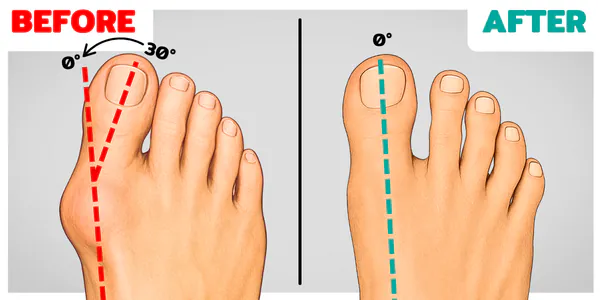
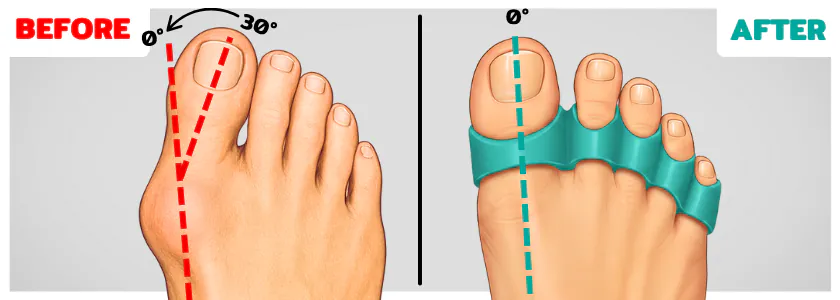
One in three people have bunions [1]. Is that due to genetics—or is lifestyle to blame?
In this post, we’ll settle the bunion debate once and for all: how much do your genes really matter, and can simple lifestyle changes actually prevent – or even fix – bunions?
Genetic Factors: 4 Traits
If you have bunions, you may have one or more of these four genetic traits:
1. Ligament Laxity
Ligament laxity means the ligaments are too loose to stabilize the joints, making them hypermobile.
In the foot, this increases the chance of the great toe drifting inwards [2]. Signs include hypermobility in the hands, elbows, and knees.
Both my sister and I have this trait, yet neither of us has bunions. So it’s clearly not the whole story.
2. Wide Feet
Wide feet, or more specifically, wider intermetatarsal angles (between the first and second toe) are linked to bunions [3][4]. The reason for this link isn’t clear in the literature, but there are clues we’ll explore later on in this post.
3. Long Great Toe
Studies show that a longer great toe is linked to higher bunion risk [4][5].
One theory says it takes more pressure during walking, so the body angles it inward to shorter the lever-arm and reduce strain [6].
Another theory is that a great toe far longer than the neighboring toes loses their support and is more likely to drift.
Neither theory has strong evidence, but we’ll return to this with a stronger explanation.
4. Rounded Metatarsal Head
Rounded big toe joints allow more side-to-side movement, which reduces stability and makes the toe easier to misalign. Flatter joints limit this movement and offer more support [4][7].
Genetics vs. Lifestyle
So do these genetic traits determine whether you’ll develop a bunion?
Twin studies suggest otherwise.
A 2016 Korean study estimated that genetics accounted for 47% of bunion risk, though it did not consider footwear[8].
A follow-up study[9] did, comparing identical and fraternal twins while adjusting for shoe habits. The genetic difference wasn’t significant.
What mattered was footwear: narrow shoes nearly tripled bunion risk, making them a stronger predictor than genetics [9].
7 Lifestyle Factors That Affect Bunion Risk
1. Pointed Toe Box Shoes
The toes should be the widest part of the foot, but pointed shoes taper inward and push them out of alignment.
I tested this by cutting open a popular sneaker and measuring my toe angle—my great toe deviated 25°, nearly equal to a grade 3 bunion on the Manchester Scale [10].
This effect is worse with a longer great toe.
It’s no coincidence that bunions and bunionettes form exactly where pointed shoes narrow.
So, a long great toe may only increase bunion risk when paired with shoes that don’t accommodate it.
The fix: Choose barefoot-style shoes with a wide toe box, that match natural foot shape.
2. Shoe Width
Even foot-shaped shoes may not be wide enough for every foot, and when they aren’t, the toes get pushed out of alignment. For genetically wider feet, this happens more often—possibly explaining their link to higher bunion risk.
Supporting this, a study found bunions in 33% of shoe-wearers vs. just 2% of lifelong barefoot individuals, despite more wide feet in the barefoot group [11].
So the issue isn’t wide feet—it’s wide feet in shoes that can’t accommodate them.
To check if a shoe fits your foot width, remove the insole and stand on it with full weight. If you have a bunion, manually realign your great toe first—your toes should fit within the insole when properly aligned.
You can also use the following test: #How to Find Your Correct Shoe Size and Fit
The fix: Visit our #Barefoot Shoe Finder and use the "X-wide" filter. This will show you brands that specifically make shoes with wider toe boxes.
3. Shoe Length
Wearing shoes that are too short raises bunion risk, even from an early age.
One study on preschoolers found a 14% increase in risk with shoes one size too small, and 30% with two sizes too small [12].
Another study revealed that 38.5% of schoolchildren wore shoes that were too short, leading to a higher prevalence of bunions in those children [13].
If toe restriction starts this young, it’s no surprise adults tolerate poor fit.
The fix: Shoes should be at least 10 to 12mm longer than your longest toe to allow for toe splay and daily swelling [14].
4. Raised Heels
Raised heels shift your weight forward, forcing your toes into the front of the shoe. Narrow shoes exacerbate this issue, adding even more pressure on the great toe [15].
A 2023 study found that even a 3 cm heel increased bunion angles. At 6 cm, the effect was much worse [16].
Heels serve no functional purpose in modern footwear. In fact, they were originally designed to help horseback riders stay in stirrups and later became fashion symbols.
The fix: Choose shoes with flat, zero-drop soles.
Shoe Checklist for Bunion Prevention
Look for shoes with:
Flat (zero-drop) soles
Toe boxes shaped like your foot
Enough width and length for proper toe alignment
The fit should allow your great toe to stay aligned and your foot to splay naturally.
You can find these types of shoes on our #Barefoot Shoe Finder
Other Contributing Factors
5. Weak Foot Arches
Weak arches cause overpronation, collapsing the foot inward and pushing the big toe into hallux valgus. Taking thousands of steps this way daily is a recipe for bunions.
Studies show a strong link between flat feet and bunions, with one finding bunions in all 32 women studied who had flat arches [17][18].
Without strong intrinsic foot muscles to support the arch, bunion prevention is almost impossible.
6. Tight Ankles
Limited ankle dorsiflexion restricts forward knee movement, so the body compensates by collapsing the foot into overpronation and using the midfoot as a “second” ankle joint [19].
This shifts excessive pressure to the great toe, which can lead to bunions over time.
This is a prime example of the body's deep interconnectedness—when restriction in one joint (the ankle) causes dysfunction elsewhere (the foot).
7. Weak Glutes
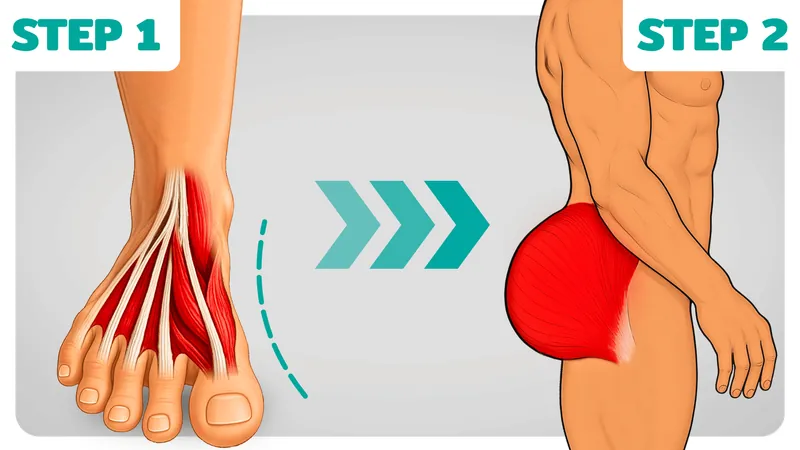
Weak glutes allow the pelvis to tilt forward (anterior tilt) and the knees to collapse inward (knee valgus), which flattens the foot arches and increases pressure on the great toe [20][21].
You can test this yourself:
Stand with feet hip-width apart, toes straight.
Let your knees drift inward—you’ll see your arches collapse and your big toes shift into valgus.
Now, squeeze your glutes.
You knees should move out, arches lift, and toes realign.
So you can see, glute strength plays a critical role in maintaining proper foot posture.
Why Are Bunions Often Only Seen on One Foot?
Genetics are symmetrical—yet many people have bunions on just one foot.
This suggests a functional cause rather than genetics.
Things like past injury, uneven mobility, or asymmetrical strength could all play a role in bunion development on one foot rather than both.
Thats why we use 10 functional tests in our #Member Consultations to identify these issues in our academy members. Your consultation will be delivered within 30 calendar days after we receive your complete intake form and all required assessment videos. If your purchase includes an earlier agreed delivery deadline, that deadline still applies.
We then use that holistic data to create a custom plan using 15-minute workouts and a library of over 100 corrective exercises to address any weaknesses.
How to Approach Genetic Risk
Genetic traits matter—but your choices matter most.
Blaming bunions on genetics while ignoring footwear or movement is like blaming sunburn on fair skin and refusing to wear sun protection.
Having a long toe or lax ligaments doesn’t guarantee a bunion. It just means you need to be more intentional with your shoes and your strength.
I have two of the four genetic risk factors, but don’t have bunions – Because I take the necessary precautions and have made the necessary fixes in my body.
The takeaway: use your genetic knowledge to guide better habits, not justify complacency.
I hope this was insightful. Drop a like down below and let me know what you think in the comments.
See you in the next one.
Cheers.
Video version of this post
Sources
The sources cited in this article. Select a small reference number to return to its place in the article.
- Prevalence of hallux valgus in the general population: a systematic review and meta‐analysis. Sheree Nix, Michelle Smith, Bill Vicenzino. Journal of Foot and Ankle Research. 2010. 1
- Finite Element Analysis of Generalized Ligament Laxity on the Deterioration of Hallux Valgus Deformity (Bunion).. Wong DW, Wang Y, Chen TL, Yan F, Peng Y, Tan Q, Ni M, Leung AK, Zhang M.. Front Bioeng Biotechnol. 2020. 2
- Hallux valgus, first metatarsal pronation and collapse of the medial longitudinal arch--a radiological correlation.. Eustace S, Byrne JO, Beausang O, Codd M, Stack J, Stephens MM.. Skeletal Radiol. 1994. 3
- Characteristics of foot structure and footwear associated with hallux valgus: a systematic review.. Nix SE, Vicenzino BT, Collins NJ, Smith MD.. Osteoarthritis Cartilage. 2012. 4a 4b 4c
- The pathogenesis of hallux valgus.. Perera AM, Mason L, Stephens MM.. J Bone Joint Surg Am. 2011. 5
- Length of the first metatarsal and hallux in hallux valgus in the initial stage.. Munuera PV, Polo J, Rebollo J.. Int Orthop. 2008. 6
- Hallux valgus in dancers: a closer look at dance technique and its impact on dancers' feet.. Davenport KL, Simmel L, Kadel N.. J Dance Med Sci. 2014. 7
- Genetic influences on hallux valgus in Koreans: the healthy twin study.. Lee CH, Lee S, Kang H, Jung DE, Song YM, Lee K, Lee K, Hwang J, Sung J.. Twin Res Hum Genet. 2014. 8
- Hallux Valgus, By Nature or Nurture? A Twin Study.. Munteanu SE, Menz HB, Wark JD, Christie JJ, Scurrah KJ, Bui M, Erbas B, Hopper JL, Wluka AE.. Arthritis Care Res (Hoboken). 2017. 9a 9b
- The grading of hallux valgus. The Manchester Scale.. Garrow AP, Papageorgiou A, Silman AJ, Thomas E, Jayson MI, Macfarlane GJ.. J Am Podiatr Med Assoc. 2001. 10
- A comparison of foot forms among the non-shoe and shoe-wearing Chinese population.. SIM-FOOK L, HODGSON AR.. J Bone Joint Surg Am. 1958. 11
- Hallux valgus in pre-school-aged children: the effects of too-short shoes on the hallux angle and the effects of going barefoot on podiatric health. Wieland Kinz, Elisabeth Groll-Knapp, Michael Kundi. Footwear Science. 2020. 12
- Relationship of the Use of Short Footwear with the Development of Hallux Valgus in a Sample of Andalusian Schoolchildren.. González-Elena ML, Castro-Méndez A, Coheña-Jiménez M, Córdoba-Fernández A.. Int J Environ Res Public Health. 2021. 13
- Increased hallux angle in children and its association with insufficient length of footwear: a community based cross-sectional study.. Klein C, Groll-Knapp E, Kundi M, Kinz W.. BMC Musculoskelet Disord. 2009. 14
- Increasing Women’s Attractiveness: High Heels, Pains and Evolution – A GMM Based Study. Jacqueline Domjanić, Darko Ujević, Bernard Wallner, Horst Seidler. 8th International Textile, Clothing & Design Conference. 2016. 15
- Relationship between High Heels and Hallux Valgus Deformity. Fact or Fiction? A 3-Dimensional Weight-bearing CT Assessment. Foot Ankle Orthop. 2023. 16
- Relationship Between Hallux Valgus and Pes Planus: Real or Fiction?. Atbaşı Z, Erdem Y, Kose O, Demiralp B, Ilkbahar S, Tekin HO.. J Foot Ankle Surg. 2020. 17
- Effects of hallux valgus deformity on rear foot position, pain, function, and quality of life of women.. Coşkun G, Talu B, Bek N, Bayramlar KY.. J Phys Ther Sci. 2016. 18
- The effect of reduced ankle dorsiflexion on lower extremity mechanics during landing: A systematic review.. Mason-Mackay AR, Whatman C, Reid D.. J Sci Med Sport. 2017. 19
- Born to Walk, Second Edition: Myofascial Efficiency and the Body in Movement. James Earls. 2020. 20
- Modification of Pronated Foot Posture after a Program of Therapeutic Exercises.. Sánchez-Rodríguez R, Valle-Estévez S, Fraile-García PA, Martínez-Nova A, Gómez-Martín B, Escamilla-Martínez E.. Int J Environ Res Public Health. 2020. 21
Watch the video
FREE 7-DAY EMAIL COURSE
Sign up for our free Strong Feet and Glutes course
Get a lesson in your inbox every day for 7 days.
Start your free course
You'll also join our newsletter. Unsubscribe at any time.