
How to Unlock Glute Strength With Core Stability
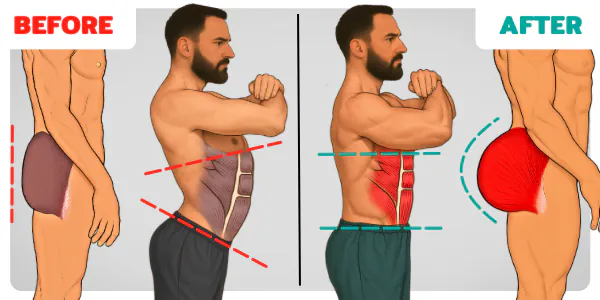
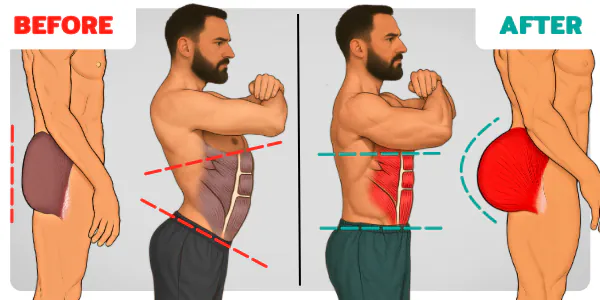
Your glutes can only generate maximum force when they push from a solid base.
That base is your pelvis.
The core's job is to hold the pelvis steady so the glutes can contract effectively.
And because the spine rests on the pelvis, keeping it stable also helps maintain a neutral spine during walking, running and lifting.
The Impact of Core Stability on Glute Function
Without core stability:
Pelvis tips forward or to the side
Glutes don’t have a steady base to work from
Lower back has to compensate, increasing strain and pain risk
Hamstrings overwork and become tight
With proper core stability:
Pelvis stays in a neutral position
Glutes can fire properly from a stable base
Force moves efficiently through the lower spine and hips
Hamstrings return to a support role and feel looser
In Summary:
Core Stability
↓
Better pelvic control
↓
Higher glute activation
↓
Less compensation from low back & hamstrings
How Much Core Stability Impacts the Glutes
Research shows that when you combine core stability exercises with glute work, muscle activation can exceed 100% of maximum voluntary contraction [1].
That’s not a typo — your glutes can actually fire harder when your core is engaged than when tested alone.
The study[1] used EMG analysis to compare common glute exercises performed both in isolation and with added core stability demands. The results show just how much more activation you get when the core is involved:
Hip Extension (quadruped position)
Glute activation: 60% MVIC
Hip Extension (plank position)
Glute activation: 106% MVIC
Difference: +46%
Why it works: A plank forces maximum core demand, which amplifies glute recruitment.
Side Lying Hip Abduction
Glute activation: 63% MVIC
Side Plank Hip Abduction
Glute activation: 103% MVIC
Difference: +40%
Why it works: Lateral core stability combined with hip abduction drives higher glute activation.
The 3 Reasons Core Stability Increases Glute Activity
1. The Stability-Mobility Rule
Your body follows a simple principle: proximal stability enables distal power [2].
In other words, you can only generate force from a stable base.
Think of how much slower you’re able to run on sand versus the road. The same idea applies to your glutes – they need a stable core and pelvis to generate maximum force.
2. Eliminating Energy Leaks
A weak core forces the glutes to waste energy stabilizing the pelvis instead of driving movement [3].
But with a stable core, the glutes spend less energy on stability and can put more of their power into movement.
3. The Co-Contraction Effect
Here's where it gets interesting: Your core muscles connect to your glutes through fascial connections.
When they contract together, it creates a synergistic effect that amplifies overall muscle activation [4].
It’s like a symphony of muscles, all working in harmony.
Assessment: Do You Have Enough Core Stability?
Take this quick test to find out:
The Side Plank Test:
Get into a side plank position on your elbow
Lift and extend your hips so your body forms a straight line
Hold this position for as long as you can
Your Score:
Less than 30 seconds = Poor core stability (your glutes are likely underperforming)
30-60 seconds = Moderate (room for improvement)
60-90 seconds = Good (your core can support proper glute function)
90+ seconds = Excellent (optimal core-glute connection)
If you scored poorly, your core lacks the stability endurance required for optimal glute function. Here are 3 steps to fix it.
How to Train Core Stability for Max Glute Output
Step 1: Belly Bracing
This is the foundation of core stability. Here's how to master it:
Stand tall and take a deep breath into your belly
Brace your abs as if someone's about to punch you in the stomach
Keep breathing normally while holding that tension
Hold for 10-15 seconds, then relax
Practice this 5-10 times a day until it feels automatic
Why it works:
Belly bracing creates 360-degree core stability, turning your midsection into a rigid cylinder that protects your spine and keeps your pelvis stable – giving your glutes a solid base to contract from.
Step 2: Learn to Move With Your Hips, NOT Your Back
If you lack core stability and have weak glutes, your lower back often takes over during movement. To fix this:
Keep your core braced and practice the hip hinge by pushing your hips back, as if sitting into a chair.
Keep your spine neutral – imagine a broomstick running from your head to your tailbone
Let your knees bend slightly, but make sure the movement comes from your hips
Film yourself from the side to check your form
Perform 10-15 reps, 2-3 times a day
The key:
If your lower back rounds or arches excessively, you're using the wrong muscles. Reset and focus on moving from the hips.
Step 3: Learn to Activate The Glutes
Wake up your glutes with targeted activation:
Lie on your back with knees bent, feet flat, and heels close to your butt
Squeeze your glutes to lift your hips into a bridge and hold for five seconds
Lower back down, then repeat 10-15 times
Pro tip:
Place a hand on your glutes to feel them contract. If your hamstrings cramp, reset and focus on initiating the movement from your glutes.
Step 4: Build Core Endurance
Strength means little without endurance. Your core needs to stay stable for entire workouts, not just a single rep:
Start with planks: work up to 2 minutes with perfect form
Add side planks: aim for 90 seconds per side
The goal:
Your core should maintain stability from start to finish without fatiguing. That's when the magic happens for your glutes.
The Bottom Line
Stop treating your core and glutes as separate systems. They're partners in power.
When your core creates stability, your glutes can do what they do best: generate force for powerful movement.
If you want to build strong glutes with our science-based system, then become a member of the Barefoot Strength Academy.
The Barefoot Strength Academy gives you:
✓ #Functional Tests to reveal exactly where your weaknesses lie—including specific tests for glute function, hip mobility, core stability, and foot strength.
✓ #15-min Daily Workouts based on your test results—no generic programs that waste time on things you don't need.
✓ #Member Chat from our team and community to ensure you're doing everything correctly.
✓ #Power Glutes & #Strong Feet learn the why behind all our methods so you can eventually become your own coach.
We've removed all the guesswork. You’ll get the exact roadmap to follow. All you have to do is show up for 15 minutes a day.
See you inside!
Chris & The Barefoot Strength Team
Sources
The sources cited in this article. Select a small reference number to return to its place in the article.
- Electromyographic analysis of gluteus medius and gluteus maximus during rehabilitation exercises.. Boren K, Conrey C, Le Coguic J, Paprocki L, Voight M, Robinson TK.. Int J Sports Phys Ther. 2011. 1a 1b
- Hip joint range of motion improvements using three different interventions.. Moreside JM, McGill SM.. J Strength Cond Res. 2012. 2
- Stability training of the lumbo-pelvo-hip complex influence stiffness of the hamstrings: a preliminary study.. Kuszewski M, Gnat R, Saulicz E.. Scand J Med Sci Sports. 2009. 3
- The effect of activation of thoracolumbar fascia on the thickness of abdominal muscles: An ultrasonographic study.. Turan Z, Özyemişçi-Taşkıran Ö.. Turk J Phys Med Rehabil. 2022. 4
FREE 7-DAY EMAIL COURSE
Sign up for our free Strong Feet and Glutes course
Get a lesson in your inbox every day for 7 days.
Start your free course
You'll also join our newsletter. Unsubscribe at any time.